The Shrink’s Links: The New Year’s Clean Sweep

Bringing you the best of mental health and relationship advice on the internet.

Today’s link from the shrink is:

The Clean Sweep Program

I’ve posted it before, but this is a link that’s worth repeating in this season of setting goals and making resolutions.

The Clean Sweep Program is a checklist of 100 items which, when completed, give you complete personal freedom. Left undone, they are 100 things that will someday bite you in the ass. You are basically taking inventory of four areas of your life: Physical Environment, Well-Being, Money and Relationships so that you can see where you fall short and set goals to square things away.

One warning, though. If you already know that your life is majorly messed up, you may not want to go through the checklist and get an abysmally low score. It may be just too discouraging. In your case, you probably already know what you need to do. Stop using drugs, restore relationships, take care of yourself, get a job. The Clean Sweep Program is best used after you overcome the most serious hurdles and you want to keep on going and not fall into complacency.

Happy New Year!

Keith

Click here to go to the Clean Sweep Program

Enhanced by Zemanta

The Shrink’s Links: Bright Ideas for Treating the Winter Blues

Bringing you the best of mental health every week.

Christmas time is a busy time of the year for malls, elves, and postal workers, but, despite the myth, it is not a busy time for us shrinks. Actually, it’s April.

Nonetheless, there is something about this time of year that makes it hard, especially in the Rochester area, to kick it into gear. It’s the time when clients complain more and more about loneliness, family conflicts, and dashed expectations. Alcoholics have more temptations to drink, overeaters to eat, and drug addicts remember the time they once hocked the kids’ Christmas to score, get guilty, and hock Christmas again just to feel better. There is something about Christmas that makes people miserable.
Why is this so? Christmas is supposed to be a happy time of the year.

Have you looked outside lately? Go ahead and do it now. What do you see?
Chances are, you can see nothing because it is dark. It’s mostly dark this time of year. Can that have anything to do with it?
It does. A lot of of heartache could be prevented by turning on a few lights.
Read this article from the Wall Street Journal to learn more.

Some Things You May Not Know About Substance Abuse, Part 20: Those who care the most about you will be the last to believe in your recovery

If you’re an addict in recovery, you may have already noticed this. Those who are closest to you are the last to believe you’re changing. Your wife, your husband, mother, father, children, close friends, don’t get as excited as you do when you celebrate one week clean, one month clean, or one year clean. They’ve heard it before. They don’t want to hear it again.

You feel offended. You wish they trusted you, believed in you.

Well, it isn’t just you. This is a universal phenomena. Your loved one is acting as your lookout. This is a good thing.

Your addiction was custom-made just for you or you would not be subject to it. It sneaks up in your blind spots. If you could see it coming, it never would’ve gotten you. It fits you like a glove. When anyone is tricked by your addiction, it tricks you first.

If you’re in a close relationship, you have a resource that others don’t have. You have a lookout. Your addiction was not custom made just for her (or him). It doesn’t sneak up in her blind spots. She spots it coming before you do. She can see through the deceptions more easily. She has a vested interest in keeping you safe from relapse. She could warn you that it’s approaching, if only you will listen.

It takes hard work to cover from addiction and eternal vigilance to keep from using again. Relapse can be expected. It takes an average of seven real attempts before recovery feels solid and, even then, you won’t know if you’re going to need eight. Moreover, addiction of all kinds will often go into hiding when it feels threatened, so that what appears to be recovery is really a more pernicious hidden phase of the same madness that troubled you before.

Paid professionals can help, they have the knowledge, they have the objectivity, but they don’t have the access your partner has. They don’t see you on the weekends and at night when triggers often strike. They do not have as much at stake.

Far too many people fail to use their lookout. The lookout sees the relapse coming and they argue with her, deny it’s happening, get defensive. This is a mistake. It’s as if a lookout on a ship, up in the crow’s nest, saw an iceberg up ahead, and the captain yelled, “You’re crazy, I’m not going to hit an iceberg. You never trust me. I’m going to do what I want. Get off my back.” It would not be good if a captain did that.

To be sure, many lookouts don’t execute their role too well. When they see relapse coming, they often make accusations, rather than observations. It’s as if the lookout, up in the crow’s nest, called out, “You’re hitting an iceberg again! Don’t you care about me?” They should just warn you that there’s an iceberg. You might be tempted to dismiss their warnings as crazed paranoia. It would not be good if you, or any captain, did that.

However, you’ve got to realize that you’ve hit a few icebergs in your day, already, and your lookout should be excused if she gets excited when she sees another one.

There’s a few things you can expect from a good lookout. Don’t be surprised when you see them.

· A good lookout doesn’t resign.

If your partner comes down from the crow’s nest and tells you that you’ve got to look out for your own addiction, you can figure that next she’ll be going off in a lifeboat. True partners do not resign as lookouts, unless they’re about to leave the relationship, or they’re a damn fool. She has to be a lookout, if only to guard her own interests.

· A good lookout stays awake.

She doesn’t watch like a hawk in the beginning and then forget about it later on. If it’s months or years since madness last struck, don’t be surprised if she still on the lookout. She has to be. That’s her job.

· A good lookout scans the horizon.

She doesn’t keep looking in the same place. The main thing to look out for is the way the madness arrived in the past. It is likely to come that way again. If, for instance, Christmas is a difficult time, then she should be especially on the lookout at Christmas time. But understand, the same difficulty can come wherever there is busy-ness, family contact, alcohol use, overeating, darkness, or an imperative to be merry.

· A good lookout is not deceived.

Addiction arrives in disguise. No one starts off drinking three six packs a day just to feel normal. No, they start off with a glass of wine at dinner, a beer during the game, or doing a shot with a friend. These things are all good things, there is nothing wrong with any of them in themselves. They are only evil because of where they lead. A good lookout sees through the disguises. She knows the masks that your addiction wears.

· A good lookout is jumpy.

She’s got to be vigilant. If you keep driving by that place where you used to score drugs, she should be seeing red flags. This may very well be the way relapse creeps up innocently.

· A good lookout raises the alarm.

If she sees relapse coming, she should say something, not keep that information to herself. You need to know it. She may not want to do it, no one wants to be the bearer of bad news, but this is what lookouts are for. If the addiction has given the two of you a lot of trouble in the past, she might not want to believe it’s back. If the addiction has already taken you over, she might get an argument.

· A good lookout keeps her eye on the hazard.

If your lookout spots a relapse approaching, she should keep her eye on it, even if you say it’s nothing. Don’t be surprised if she looks for confirmation in the form of a home drug or alcohol testing kit to eliminate suspicions. She may want to get a second opinion from a professional; sort of like calling in another lookout and asking what he sees.

· A good lookout keeps herself safe.

She shouldn’t be so busy being a lookout, watching out for your relapse that she gets overcome by her own kind of madness. Yes, everyone, even your partner, has her own kind of madness.

· A good lookout has someone looking out for her.

Be your partner’s lookout, just as she is yours. Watch each others’ backs. You can see her madness more clearly than she can her own. If your partner has been dealing with your addiction for a long time, she’s probably worked very hard to keep herself strong. Someone in the house had to function. The laundry, the cooking, the kids, the relatives, the shopping, and going to work don’t get done by themselves. She may not be accustomed to relying on you for anything; you just haven’t been reliable. That’s going to have to change. She needs a lookout, too.

If you’ve ever complained that your partner doesn’t trust you, let her be your lookout. This is how she learns to trust you again.

Some Things You May Not Know About Substance Abuse, Part 18: You don’t know what you can do

You could learn a lot about addiction and recovery by watching the Wizard of Oz.

I’m not referring to the scene where Dorothy and her friends pass out in a field of poppies. That’s the only outright drug reference I can recall. I’m talking about the way Dorothy and her friends are traipsing all over Oz, trying to find the Wizard who can give them what they need. You remember. Dorothy wants to go back home. The Tin Man wants a heart, the Scarecrow a brain, the Lion, some courage. They’ve all been told the Wonderful Wizard of Oz can get them what they want.

Dorothy and her friends go through quite a lot of trouble for the Wizard. Together, they confront the Wicked Witch of the West and her posse of terrifying flying monkeys. Dorothy gets captured, the Scarecrow, Tin Man, and Lion demonstrate considerable ingenuity, loyalty, and bravery to sneak into the castle, and Dorothy unexpectedly murders the witch with a bucket of water.

I hope I’m not spoiling it for you.

They return to the Wizard and demand an audience. There they find the man behind the curtain. They discover the Wizard is a fraud.

Things couldn’t get worse for Dorothy and her friends at this point, it seems. Here they are, Dorothy, stuck in Oz, the Scarecrow, brainless, the Tin Man, heartless, the Lion, without his courage, and the Wizard, with no power to help. They went through all that for nothing. It couldn’t get much worse than that.

The Wizard certifies the intelligence of the Scarecrow by presenting him with a diploma. He confirms the Tin Man’s humanity by giving him a ticking heart-shaped watch. He awards a medal to the Lion for his courage. By this point, you know that these characters had these qualities all along. They just needed someone to say so.

The thing that saves the day for Dorothy is that, unbeknownst to her, she had possessed, the whole time, the very means by which she could return to Kansas: the Ruby Slippers. A few clicks of the heels and she’s back in the loving care of Auntie Em.

I think you can see the parallels between the plot of this story and addiction. The object of addiction, the drug, is the Wizard. The addicts confer wondrous powers onto the drug. They’ll do anything for it because they believe it’s the very thing they need. They run grievous risks and commit horrendous crimes for its sake. Then, at some point, they discover the drug is a fraud. It does not have the powers they thought it had. It does not, cannot, give them what they want. This moment of awareness is an awful one. People do not want to feel that way, so they’ll engage in denial and hold out hopes in the power of the drug long after it’s reasonable to do so. However, becoming aware that the drug is a fraud is a necessary step in the process of recovery.

If that was all recovery consisted of, it would not be such a good thing. If all that you experienced in recovery was that the drug is a fraud and you have been wasting your time, then you might think you might as well slit your wrists. Fortunately, there’s more to learn. You can learn that all the qualities you looked for in the drug, you already possess. Indeed, you may have even demonstrated these qualities as you sought the drug.

The man who wakes up every morning, sick, homeless, and broke and, somehow, finds a way to raise money for smack should be teaching MBAs at Harvard. The crack whore, who, against all reason, braves the hazards of the street for a moment of pleasure, Medal of Honor winners should be saluting her. The sex addict who deceives and eludes the person closest to him; who knows him best, should get an Oscar for his performance. If addicts could recognize the qualities they have, they wouldn’t need the drug. If they could use those qualities towards an objective other than obtaining drugs, they could go far in life.

This is why you might not realize you already possess great powers. You started off life as child, utterly ineffectual and enthralled by the capabilities of the big people around you. You got used to being helpless. You may have even liked it and preferred depending on someone or something else, rather than taking responsibility for yourself.

Another reason you might not know you have great powers, is that you have not had a reason to use them.

This is how self discovery works: A boy, when he is growing up, is always getting beaten by his big brother in basketball. He believes he’s just not that much of an athlete, so be becomes a bookworm, instead. He gets good grades and is accepted into Harvard. There, on the Harvard Yard, he begins playing Ultimate Frisbee with the other bookworms. He discovers, out of the shadow of his big brother, that he’s more athletic than he thought.

As life goes on, he discovers more things about himself. Having spent so much time in school, he doesn’t believe he can succeed in the real world, until get gets a job and does just that. He dates lots of people and believes he is incapable of commitment, until he meets the right girl and cannot think of anyone else. His first child is born and he is overwhelmed by the terror of having to raise another human being, but he goes on to be a good father. The point is that we never know what we can do until we try.

Of course, trying something requires a key ingredient: courage.

What makes a king out of a slave? 
    
Courage! 
    
What makes the flag on the mast to wave? 
    
Courage! 
    
What makes the elephant charge his tusk in the misty mist, or the dusky dusk?
What makes the muskrat guard his musk? 
    
Courage! 
    
What makes the sphinx the seventh wonder? 
    
Courage! 
    
What makes the dawn come up like thunder? 
    
Courage! 
    
What makes the Hottentot so hot?
What puts the “ape” in apricot?
What have they got that I ain’t got?
    
Courage.
(Sung by the Lion in The Wizard of Oz, Movie, 1939)

The Lion was right to desire courage. Without the courage to use them, no other qualities count for anything. Here’s the thing, though. You don’t possess courage before you use it, you develop it while in the act of using it. You create it while facing your fears.

The Shrink’s Links: The Advent Conspiracy

Bringing you the best of mental health every week.

There are only twenty-four more shopping days until Christmas.

What’s the matter? Not feeling very merry? Maybe it’s time to change the way you celebrate Christmas.

Click here to join a conspiracy to make Christmas simpler and more meaningful.

Some Things You May Not Know About Substance Abuse, Part 17: Recovery is easier than you think

All this reading about substance abuse and recovery may have given you the wrong impression. You may think that it’s hard to stop using drugs. Maybe it is, but nearly everyone who has experienced both addiction and recovery say the same thing: recovery is far easier than addiction.

You’re accustomed to all the work it takes to keep up an addiction, so you might not notice it anymore. You’re not accustomed to the work it takes to recover. It seems hard to decline your first impulse, to be honest with yourself, to go to meetings, and to open yourself up to healthy influences; but, in almost every case, you will wonder why you put it off so long. It’s not hard, it’s just different.

Let’s look at all the work involved in keeping up an addiction. You’ve got to get the drug. It’s rarely cheap and often involves going to a bad neighborhood and dealing with unsavory characters. You often get ripped off, run legal risks, and have to act secretly.
Then, you’ve got to use the drug. It sometimes involves the fuss of cooking and the pain of needles. It tastes bad, makes you cough, or gets you dizzy. You’ve got to stand out in the weather or hide yourself in the bathroom. You sometimes have to use it, even when you don’t crave it; like when you pull out your cigarettes before going into a movie theater because you won’t be able to smoke till the end.

Finally, you have to recover from it. There’s the hangovers, of course, the withdrawal, the delirium tremors. You’ve got to deal with the fallout from your spouse, the disappointment from your children, the criticism from your parents. There are lies and excuses you have to think up, and then remember what you said to whom. There are health issues. You’ve got piss tests at work and teachers looking closely at your eyes at school. Judges and probation officers don’t take kindly to chemical use and neither do old friends who know how you used to be.

Oh, there’s also the phenomena of increased tolerance. The more you use the drug, the less effective it’s going to be. You chase that first high and never experience that delight and wonder again. It gets to be that you can’t even get high anymore, but you use only to feel normal again.

People in the beginning and middle of addiction seldom think of all the costs involved. All those kids, smoking in front of the school are not saying to one another, Look at me, I’m starting a habit that going to cost me thousands of dollars a year, will make me stink, cause me to be socially ostracized, discriminated when I apply for insurance, give me cancer and heart disease, and bring me to an early grave. You think that’s what they’re saying to one another? No, they’re talking about how cool they look, how grown up they feel, and how no one else understands.

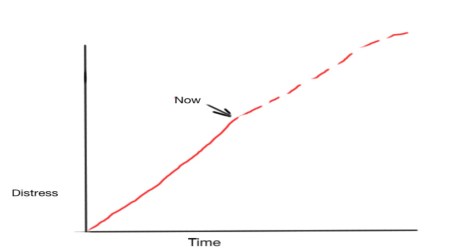
Let’s take a look at the decisions involved when you make the choice whether to use drugs or not. You probably use in response to a distress of some kind. It may only be the distress of the craving, itself; or you may use drugs as a way of coping with some anxiety or depression. Either way, you experience distress and assume you’re going to continue to experience distress unless you do something about it. The situation is depicted in this graph.

Image001

The vertical axis represents the level of distress, the horizontal axis, the passage of time. Your distress grows over time, until it gets to the point where you are now. You imagine that it’ll just get worse. You feel you have to do something fast.

What do you do? If you’re an addict, you use your drug.

Image002

Your distress level plummets pretty fast. You think, it’s a good idea you drank, shot up, or smoked, then.

But, there’s one problem, you don’t know what would have happened if you didn’t use your substance.

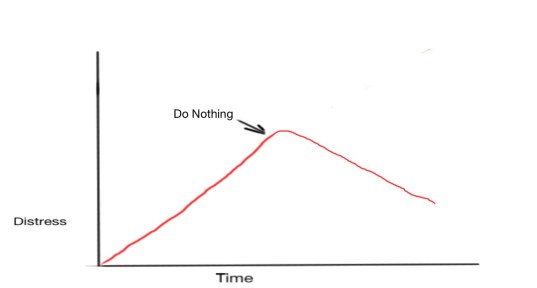
I’ll tell you what would have happened. What would have happened is what always happens. Things regress to the mean, people get used to anything, thoughts end, feelings go away, you get distracted. If you don’t do anything, it looks like this:

Image004
If you knew this, you’d feel like a fool, using drugs. All that cost, all that risk, all those consequences, all to get exactly where you would have gotten if you did nothing.
Well, if you feel like a fool looking at that graph, then look at what happens when more time goes by and all the costs, risks, and consequences of using drugs play out.

Image005

How do you like them apples?

This same graph works just as well with almost all kinds of distress and other things we do to intervene: shopping, getting in a fight, avoiding issues, hurting yourself, or killing yourself. We rarely know what the consequence of doing nothing is because there seems to be an imperative to always do something to relieve distress.

I used to advise people to learn to sit with feelings. If you feel angry, sad, nervous, or scared, see what happens if you do nothing. Study the feeling, contemplate it, and experience it before you act on it. You’ll find that, whatever feeling you had just went away and didn’t stick around long enough for you to study anything. So, I don’t say sit with your feelings because your feelings don’t sit. They travel. Watch them go by.

It’s easier than you might believe.

Some Things You May Not Know About Substance Abuse, Part 16: You don’t have to use drugs to use drugs

A recovering alcoholic goes to a party in which there’s alcohol being poured. He’s determined to stay sober, but he doesn’t want to stop going to parties. All his friends are going to be there. They’ll be watching the big game on the big screen. It’s bound to be a great time.

He does all the things to ensure that he’ll stay sober at that party. He has good reasons to stay sober. They’re all written down on a laminated index card he keeps in his pocket. He brings someone who will support his sobriety. He has an alternative beverage. He has some lines worked out in his head to say if someone offers him a drink and some more lines if they persist. He parks his car so he can make a quick getaway if he has to.

Chances are, that person is going be successful at staying sober at that party. But, chances are, two days later, he’ll relapse when the pressure is off and he has no reason whatsoever to drink. I’ve seen it happen a hundred times.

What is going on?

Drinking alcohol got in his head. Not the alcohol, itself, but the idea of it. A lot of times, that’s all you need.

A recovering drug addict drives to meet a prospective customer on the far side of the city. On the way, he passes by the abandoned building where he used to score dope. He’s not going there to get dope, he’s just driving by. He has no interest in getting high. He’s been there before and doesn’t want it again. Things have gotten much better for him since he began his recovery. He has this job, for one. He’s back with his old lady. His kids are talking to him. Using drugs again would be just crazy.

But then, as he drives by the old drug house, he gets this funny feeling. Something tightens up in his chest. His stomach goes queasy. You know what? He gets a little high. He hasn’t done anything more than drive by the old drug house, but that’s all he needs to do. He doesn’t get as high as in the old days. It’s not like that; but the excitement is still there.

You know what he does? He goes on to his meeting. If he tells anyone about his drive past the old drug house, he tells them about how he was able to pass by, without relapsing. His old lady congratulates him on his success. He’s feeling pretty good about himself.

A week later, he drives by again. This time, it’s not really on his way. The same thing happens. He gets a little high; and, just like before, that’s enough.

A week after that, he drives by again. This time, he pulls over and has that feeling a little longer. You guessed what happens eventually. As they say in the meetings, if you keep going to the barbershop, one of these days you’ll get a haircut.

This is what’s known as a contact high: the high you get when you’re in the vicinity of your drug. The term is sometimes mistakenly used for the high you get when you imbibe second hand smoke or handle a drug with your hands so that it passes through your skin. You can get high by imbibing secondhand smoke and handling drugs with your bare hands, but that’s not properly called a contact high. A contact high occurs psychologically, not physiologically. It’s all in your mind.

We shouldn’t be surprised by this. It’s related to the placebo effect. When scientists are researching a new medication and want to test it, they will give the new medication to a group of people and study the effects. They’ll take a second group of people and give them a pill that looks just like the new medication. They will tell them it is the new medication, but it’s really just a sugar pill. The sugar pill is called a placebo. Then they’ll study the effect of the placebo.

Placebos always are effective to some degree. For instance, when they conducted the trials for Prozac, a popular and important anti-depressant, the placebo was effective in about half the cases. Prozac was effective in about two thirds of the cases. That’s not a huge difference, but I guess it was enough to say that Prozac works. Still, when Prozac works, it’s a pretty good chance that it works because the patient believes it will work, rather than because of some physiological effect.

People who believe that everything comes down to cells and chemicals are mystified by the placebo effect, but the phenomenon has been used and abused by both healers and charlatans, for good and ill, for centuries.

Words are the most powerful drugs used by mankind. Kipling

I once had a client who was very anxious. Nothing seemed to help her and the medicine she was taking for it was actually harming her. Her doctor hatched a scheme. He told her they had discovered a new, very powerful medicine. He would put it on her and discontinue her old medicine. The new medicine was a placebo, but he went through the usual song and dance doctors go through, describing all the side effects. He was making them up, but he needed to make it believable. She took the new medicine.

A couple weeks later, she saw her doctor again. All her symptoms of anxiety had disappeared, just like he said they would, but she was also getting all the side effects. She couldn’t tolerate the side effects, in fact. She refused to take any more of the medicine.
Here’s another story. I once worked nights selling drinks at a teenager’s nightclub. We had no alcohol there, of course; it was all just sodas and juice; but, one week the owner had gotten a couple cases of non-alcoholic beer.

A few of the kids were pretty excited to see the beer. They either didn’t hear or didn’t understand that it was non-alcoholic. It looked like beer. It tasted like beer. They started drinking it, pounding it, really; just as hard as their big brothers might at a frat party. You know what? They got just as drunk as if they had been drinking real alcohol. They would have passed a breathalyzer test, but wouldn’t be able to drive real well. We actually talked them into surrendering their keys and calling their parents. Boy were the parents mad when they thought we had been giving beer to their children.

So, you see, it is not necessary to actually use a drug to be effected by a drug, and it’s possible to relapse without ever actually touching the stuff.

The Shrink’s Links: 7 Cups of Tea

Bringing you the best of mental health every week.

If you’re a good listener or need a good listener, then 7 Cups of Tea might be just your cup of tea.

7 Cups of Tea is an on-demand service that connects you anonymously & securely for a one-on-one chat.

Whether you want to discuss the meaning of life or question whether it’s worthwhile to live it, got a burning desire to complain about the bad call that caused the Bills to lose the game or want to tell someone, anyone about that shameful thing you did, have a cup of tea with 7 Cups of Tea. Their listeners won’t judge or solve problems or tell you what to do; they’ll just listen. They give you the space you need to help you clear your head.

Click here to go to the site

Some Things You May Not Know About Substance Abuse, Part 14: Help is Closer Than You Think

It is a whole lot easier to get substances that will addict you than it is to get into treatment for addiction. In many localities, there are drug dealers at every corner, but to get to a clinic, you have to take two buses. Intake coordinators will make you wait in a room with old magazines and ask you million questions; but bartenders will serve you right away and leave you alone if you don’t want to talk. Insurance companies will seek to deny you coverage, but you can buy as many packs of cigarettes as you want on your credit card. You can get narcotics from every doctor, but it’s tough to find one who prescribes Suboxone (AKA: Buprenorphine), a medication that can assist you in getting off narcotics. There’s even an act of Congress that limits your access.

Suffice it to say that it’s a lot easier to get substances that will addict you, than it is to get into treatment.

However, that’s not the same as saying that help is far away.

Practically every church basement hosts an Alcoholics or Narcotics Anonymous meeting. If your town is large enough, there will be one every day of the week. They don’t cost anything, but they will pass the hat to buy coffee. There are no forms, no appointments, no one to call for pre-approval, no side effects. You don’t have to take time off from your job. You don’t have to give them your whole name. You don’t have to speak. You don’t even have to stop using. You just have to have the desire to stop. They can’t make it any easier than that.

But it’s still not easy to go to AA or NA. I’ve found there are two big barriers that get in the way.

The first is that you will have to deal with people. There will be people there who are either not serious enough about recovery or too serious. There will be people there to pick up women and women there to get picked up. There will be judgmental ones and understanding ones. If you speak, they will answer you with simplistic slogans and facile quips. Some will smell. Many will smoke. They all will remind you of the worst moment of your life and forbid you from forgetting it.

They are much the same as the people you will find in a bar or a drug house. The people who meet in the church basement are little different than the ones who meet upstairs, in the church, although they don’t dress up and are less sanctimonious.

The second barrier that people have to attending AA or NA is the insistence those organizations have in using a higher power. The Higher Power is mentioned everywhere. You can’t even get past the second step without them bringing it up.

Step One is, We admitted we were powerless over [fill in the blank] – that our lives had become unmanageable.

The bars and drug houses are filled with people who admit they are powerless over their addictions. They may forget sometimes, but they know it. Having this knowledge is not enough. Hitting bottom is not enough. There has to be some hope.The hope is supposed to come in the form of Step Two.

Came to believe that a Power greater than ourselves could restore us to sanity.

It’s that second step that stops many people. They have too much baggage associated with the Higher Power.

Religious institutions have, over the centuries, done a pretty good job of marginalizing the very people that populate most self help meetings. For that matter, addicts have done a pretty good job at doing the things that piss church people off. Furthermore, the idea of God, for many addicts, never matured. Their idea of God is often a child’s idea of God, like with the beard and thunderbolts, smiting people from up in Heaven, and all that; or the adolescent idea of God, concerned about what group you belong in, who’s in and who’s out. There are all kinds of problems and hangups that hold people up in the second step.

If you have trouble with the Higher Power, let me introduce you to something you may be able to wrap your head around.

Every addict knows he or she is divided into two parts. There is the addicted part that sets you up, talks you into using, chooses associates from among those who use, chases away those who don’t, scores the dope, shoots the needle, heaps the guilt, and refuses the help.

Then there’s the other part. The part that wants to stop, that refuses to use, sometimes, that makes healthy connections, apologizes for the hundredth time to family, hates the dope, loathes the needle, knows he can do better than guilt, and looks for help.

Most addicts think the first part, the addicted part, is more real. They identify with the first part. That’s the self, they say. But the second part, the healthy part, is real, too; although it may be, as yet, unrealized. There are two parts to you, although you might only know the first.

Which of the two parts would be the higher?

The healthy part, I thought so. There’s your Higher Power.

If you cannot connect with the idea of the Higher Power many people have, or with your old idea of the Higher Power, connect with the healthy side of yourself as your Higher Power. Get to know it, listen to it, confess to it, rely on it, let it guide you.

Help is closer than you thought.