The Shrink’s Links: Minimalism

Bringing you the best of mental health every week.

Links

Less is more.

Less clutter, fewer time commitments, negative thought patterns and toxic relationships equals more time, space and energy for things that really matter to you.

Do I really need to say more?

Click here to go to the site and learn how to free yourself of the madness of maximumism.

The Shrink’s Links: Mindfulness Apps

Bringing you the best of mental health every week.

chain2

You don’t need an app to be mindful. As a matter of fact, getting rid of that phone and the laptop and the computer for a day, or even an hour, and paying attention to the here and now might be a great exercise in mindfulness. But, if nothing seems real to you, or possible, unless there’s a app for it, then here’s the place to start: a place that lists a bunch of mindfulness apps.

Click here to go to the site.

The Shrink’s Links: The Smokefree Way

Bringing you the best of mental health every week.

Chain4

Sometimes I get new books to review. I just finished The Smokefree Way by Tamir Turgal. As an addiction counselor, I’ve read many books and heard many people talk about addiction and the process of setting oneself free. I’ve never read anything as clear and direct as this one.

Turgal offers a cognitive approach to recovery from addiction to tobacco, perhaps the most persistent and frustrating addiction of them all. When most people try to quit smoking, they gravitate towards the biochemical treatments of puffing, patches and pills. But, what Turgal says is needed, is a change in thinking. He exposes many of the delusions, excuses, misperceptions, and lies that keep people stuck in their addiction.

For instance, many people are overwhelmed by how hard they think it is to stop smoking, forgetting how hard it is to keep smoking. When you smoked your first cigarettes, you didn’t feel good, you were coughing and dizzy, but you persisted. For a few days after you smoke your last cigarette, you also don’t feel good; but, if you persevere, you’re free. Yeah, you’re grouchy when you quit. Temporarily. But, when you smoke, you stink. Sure, when you quit, you gain weight. Temporarily. When you smoke, you can’t breathe, Quitting requires some sacrifices. But it’s costly to smoke, time consuming, and shaming. Quitting is hard, but it’s no harder than smoking.

Turgal deserves an award for cutting through the bullshit, the smoke and mirrors, that surrounds cigarettes.

Click here to go to the website.

The Shrink’s Links: Intersections

Bringing you the best of mental health every week.


When I’m not shrinking heads, or writing about shrinking heads, I’m often writing fiction. For instance, I have another blog, At the Epiphany Cafe, where I experiment with new ideas and characters under the pen name, S Harry Zade. When these ideas and characters work they eventually become a book. One such book, Intersections, just came out. Maybe you’d like to read it.

Click here to go to Intersection’s Amazon website.

What Color are Your Glasses?

Rose-Colored-Glasses

You know what rose colored glasses are, right? People who are said to be wearing rose colored glasses are said to be seeing the world as only pleasant and happy. We scoff at people wearing rose colored glasses. They are naive, sanguine, and overly optimistic. But, glasses come in all colors. They all distort your perception.

It’s important to know what color your glasses are, so that you know how you are misperceiving the world and the impact you have on it. The glasses you wear change both how you see the world and how the world sees you.

There are red colored glasses. People wearing them walk around seeing red. Everything is a threat to them and they must take action immediately to remove it. They’re on edge, ready for anything. They get angry all the time and figure that everyone is angry with them.

If you don’t know what color glasses you wear, you can check by comparing your perception with someone else’s. If they’re looking at the same thing you are, but coming up with vastly different conclusions about it, then you know that one of you, or both, are wearing colored glasses. However, you’ve got to pick someone who thinks differently than you and sees the world as a different place; otherwise you are only confirming your own bias.

There are blue colored glasses. You put them on and you get the blues. Perhaps having the blues helps you sing well, but you’re so preoccupied by what you don’t have and what you’ve lost that you forget what you do have.

Having colored glasses is a lot like having a car that needs a front end alignment and pulls to one direction. If you keep your hand on the wheel and compensate, you’re fine. If you let go and allow the car to steer itself, you drift off the road or into oncoming traffic.

Back when I ran a sawmill, I couldn’t look at a tree without counting up how many two by fours I could get out of it. I don’t know what color glasses those were, but it was hard to simply get pleasure from trees. You find a lot of people like that, so preoccupied with their work that they can’t kick back and enjoy.

There are some that have a different pair of glasses on every day and see the world differently on Tuesday than they do on Thursday. They may believe they had it all wrong before, but now they have it right; or they may conclude that they can’t trust their own perception on any day of the week.

I suppose there are yellow colored glasses that expose cowardice, green colored glasses that make everything look like money, and purple colored glasses that allow you to see fairies and unicorns. The colors and varieties are endless because there are infinite mistaken ways we can perceive; but, because there is only one world out there, there is only one way we can perceive accurately.

The worst are the shit colored glasses. Wear them and everything looks like shit.

If your view of the world does not change from day to day, then maybe it’s not colored glasses that are affecting your view of the world, maybe it’s your eyeballs that are tinted. Maybe you can’t do anything to significantly change your perception. People are born with different temperaments; they have different happiness set points, degrees of reactivity, and levels of affability. You’re well off when you just know what your default setting is, and make adjustments accordingly.

Is there anyone who sees the world accurately? Anyone whose view is not tinted by their own biases, prejudices, and preconceptions? I don’t see anyone, but maybe that’s my bias; I haven’t checked everyone yet; and, even if I did meet someone who had it all right; how would I know?

This, I can say for certain, though. The person who questions her judgment, who checks out her perceptions with others, who is always willing to be proven wrong and to learn something new is more likely to be more right than anyone else.

How to Live Up to Your Potential

Let me introduce you to another object in my office: the jade plant.

Jade

This plant, I think you will agree, is a beautiful specimen; as good as a jade plant can be. It is lush and green and healthy. It propagates well. It has lived a long time.

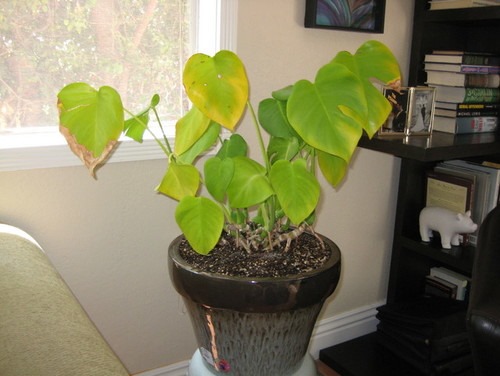
Let me show you another plant, a philodendron.

philo

I think of these two plants whenever I think of the concept of teleos, defined as a thing’s design, meaning, purpose, or potential. All living things are programmed to fulfill their teleos and cannot rest until they do. The jade plant is living up to its teleos. It is being the best damn jade plant it can be. It’s everything that the original jade seed was programmed for when it began to grow. The philodendron: not so much. Something is standing in its way from being the best it can be.

Botanists say that it is a plant’s teleos will determine the shape and color of the leaves. All plants will grow towards the light. If you break off cuttings and put them in soil, they will grow roots; but these roots will limit in that they cannot ambulate anywhere. They are at the mercy of their circumstances and the water and sunlight available to them.

When a client decides to come to my office, they often look and feel more like the philodendron than the jade. Something is standing in the way of fulfillment. They are not living up to their potential and they feel a teleological imperative to do something about it, so that they can continue to grow.

Let me show you another picture. Someone who has never set foot in my office.

miss-new-york-miss-america-2015

This is Kira Kazantsev, the reigning Miss America. Although some may say she’s too skinny, the Miss America judges thought she was very pretty; as beautiful, in her own way, as the jade plant in my office. Is she fulfilling her teleos, though? Is she living up to her potential? The teleos for people is different than it is for plants.

For one thing, all a plant has to do is sit there and look pretty. I guess all Miss America has to do is look pretty; so, as far as that goes, she’s fulfilling her teleos; but she’s not only the reigning Miss America: she’s human, too, and there’s a lot more to a human’s teleos than looking pretty.

Let me show you another image, a famous one this time, by Dorothea Lange.

Lange-MigrantMother02

No judge at the Miss America contest would ever say that this woman was pretty. There are wrinkles and imperfections in her skin. Her hair is relatively lifeless. We can’t see her teeth, but, if we could, it would not be hard to imagine that they are bad. Her clothing is old and needs attention. Moreover, there is a general aspect of careworn worry. She does not have happy children. She is clearly not fulfilling her teleos. Or, is she?

To really understand how one is doing teleos-wise, we need to go further than to just look at images; you have to know the narrative. Let me show you what I mean with respect to the plants. Let me tell you something that’s not obvious when looking at the images I gave you.

The jade plant has a distinct advantage over the philodendron. It has a privileged position by a sunny window, while the philodendron has not been getting sun. The philodendron may be doing the best it can do with the resources given to it.

The same could be said of the woman in the Lange photograph. If you know the story behind it, you know that this woman was a migrant farmworker, living in a tent in California, a refugee from the dust bowl during the Great Depression. I think we can cut her some slack.

Let’s see if we can define a human’s teleos. A human embryo is programmed to grow two arms, two legs, a top-notch brain, and hands with opposable thumbs. It will eventually walk upright. Because a human can walk, she will move to another area if resources are lacking where she is. Because of the brain and thumbs, she will ingeniously adapt herself to every circumstance. She will care for her children longer than any other species, even when she barely has enough to care for herself.

You might even say that, just as a plant requires sunshine to fulfill its teleos, a human requires adversity to fulfill hers. She must not like it where she is, so she will move. She must encounter trouble, so she will change. She has to feel like a misfit, so she can adapt. If you look at the determination and dignity of the woman in the Lange photograph, you might say that she fulfills her teleos better, for all her trouble, than another who has enjoyed more advantages, even the reigning Miss America.

The Shrink’s Links: After Virtue

Bringing you the best of mental health every week.

Chain3

If you’re interested in living a good life, you first need to know what the good life is. To figure this out, try studying philosophy. There’s no better person to do this with than Alasdair MacIntyre, who wrote After Virtue.

When you do philosophy, you can’t just believe what people, institutions, or scriptures say, you have to arrive at your conclusions on your own. You also can’t just go with your emotions. Philosophers don’t trust emotions. They want to know the reasons for things and have reason make the decisions.

When you’re engaged with natural sciences you can find truth in the experimental data, but in the social sciences, you just can’t run the same kind of experiments our colleagues down the hall in physics and biology can, nor can you be as confident in you results. Consequently, when we try to say what we think is virtuous, good, and true, we are doing little more than expressing our emotions.

MacIntyre says we can identify the virtuous, good, and true, without resorting to feelings, by using the Aristotelian concept of teleology. A teleos is a given thing’s objective. For example, an acorn is meant to grow into a fully formed, beautiful oak tree. Many acorns do not. Many get eaten by squirrels, others grow in bad ground, get crowded, get chopped down, or become diseased or eaten by insects. Many fail to achieve their teleos. Just the same, the acorn is programmed to become an oak tree. MacIntyre suggests that, if we want to know what is good, we should refer to the teleos. What is good for an acorn is growing into an big, beautiful oak tree, therefore the effect of squirrels, bad ground, crowed forests, axes, disease, and insects is bad. So is remaining an acorn forever and not growing at all.

When you read philosophy, you recognize a lot of the assumptions you make and where they come from. For instance, I’ve written again and again that life and relationships go better when people act like adults. I now see why I think this is better. When you act like an adult, you are fulfilling your teleos.

Of course, Aristotle and his concept of teleos don’t answer all the questions. For instance, even if we agree that fulfilling one’s teleos is good; what is one’s teleos? Is the teleos of a homicidal, anti-Semitic tyrant to murder six million Jews? If so, then Hitler was good. I think, because most of us don’t want to say Hitler was good, we’ll say that couldn’t possibly be his teleos. We say, instead, that Hitler had the same teleos as the rest of us, but he was like one of those stunted oak trees, knocked down by a windstorm, and grown into a bizarre, un-oak-like shape.

That’s all well and good, but aren’t we right back to being guided by emotions?

Click here to listen to a podcast discussion of McIntyre on The Partially Examined Life.